
- 05.05.2022
- Array
- Array
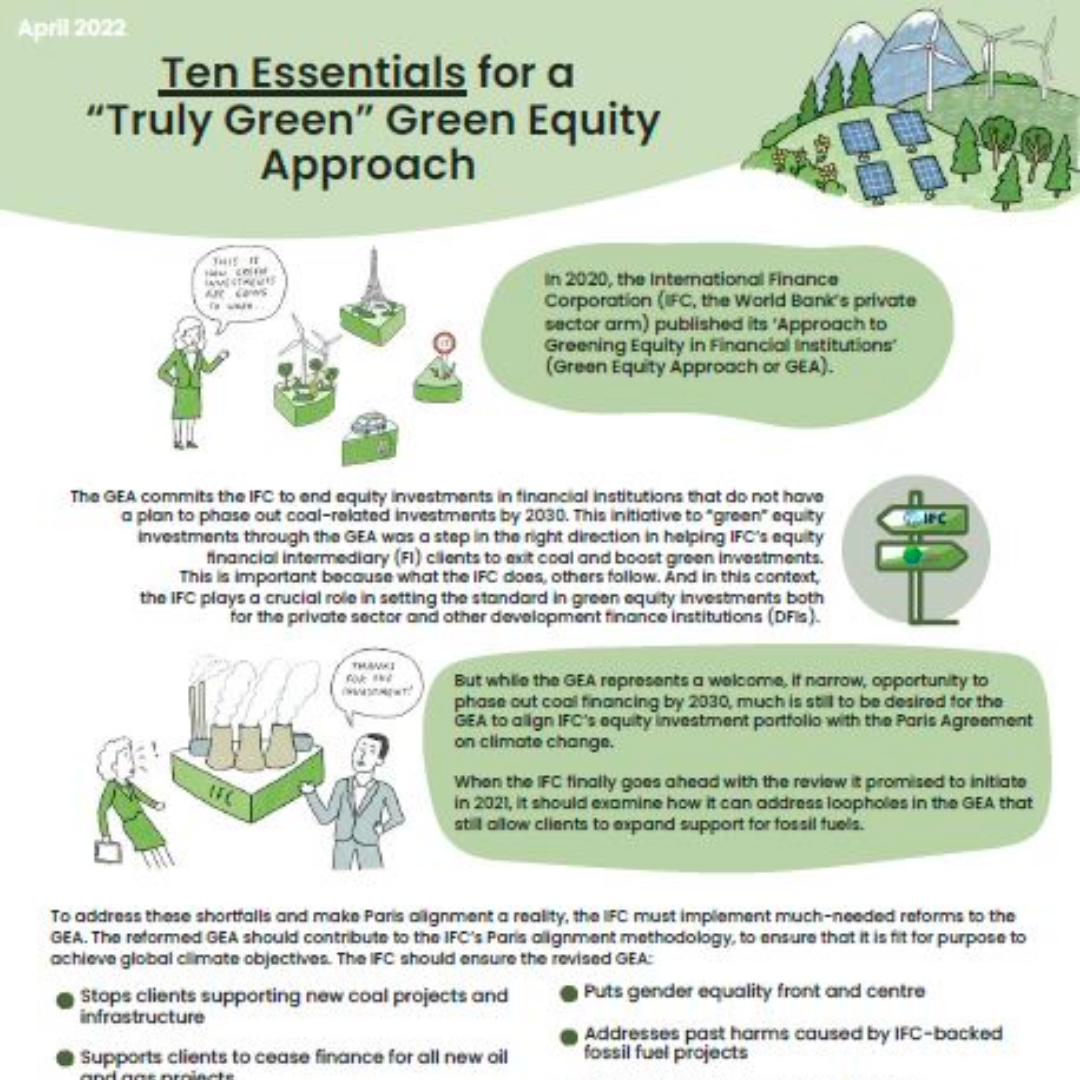
In 2020, the International Finance Corporation (IFC, the World Bank’s private sector arm) published its ‘Approach to Greening Equity in Financial Institutions’ (Green Equity Approach or GEA).
The GEA commits the IFC to end equity investments in financial institutions that do not have a plan to phase out coal-related investments by 2030. This initiative to “green” equity investments through the GEA was a step in the right direction in helping IFC’s equity financial intermediary (FI) clients to exit coal and boost green investments. This is important because what the IFC does, others follow. And in this context, the IFC plays a crucial role in setting the standard in green equity investments both for the private sector and other development finance institutions (DFIs).
But while the GEA represents a welcome, if narrow, opportunity to phase out coal financing by 2030, much is still to be desired for the GEA to align IFC’s equity investment portfolio with the Paris Agreement on climate change. When the IFC finally goes ahead with the review it promised to initiate in 2021, it should examine how it can address loopholes in the GEA that still allow clients to expand support for fossil fuels.
To address these shortfalls and make Paris alignment a reality, the IFC must implement much-needed reforms to the GEA. The reformed GEA should contribute to the IFC’s Paris alignment methodology, to ensure that it is fit for purpose to achieve global climate objectives. The IFC should ensure the revised GEA:
- Stops clients supporting new coal projects and infrastructure
- Supports clients to cease finance for all new oil and gas projects
- Supports clients to scale up investments in sustainable renewable energy
- Ensures more clients adopt the GEA
- Closes the coal underwriting loophole
- Puts gender equality front and centre
- Addresses past harms caused by IFC-backed fossil fuel projects
- Ensures transparency and full public disclosure
- Allows for an evidence-based, public review of the GEA
- Ensures a rights-based approach and meaningful participation